When Audiences Stop Trusting Their Writers
Euphoria, Sam Levinson, and how audience trust shapes the way we interpret a story.
June 6, 2026
The new season of Euphoria has sparked an interesting reaction. Not because the characters have changed—that was inevitable after a multi-year time jump—but because much of the audience seems to have arrived with a preexisting suspicion: they no longer trust the people writing it.
And when audiences lose trust in their writers, the way they consume a story changes entirely.
The best works invite analysis because they convey a sense of intention. Viewers feel that every decision points toward something larger, even when they cannot yet see the full picture.
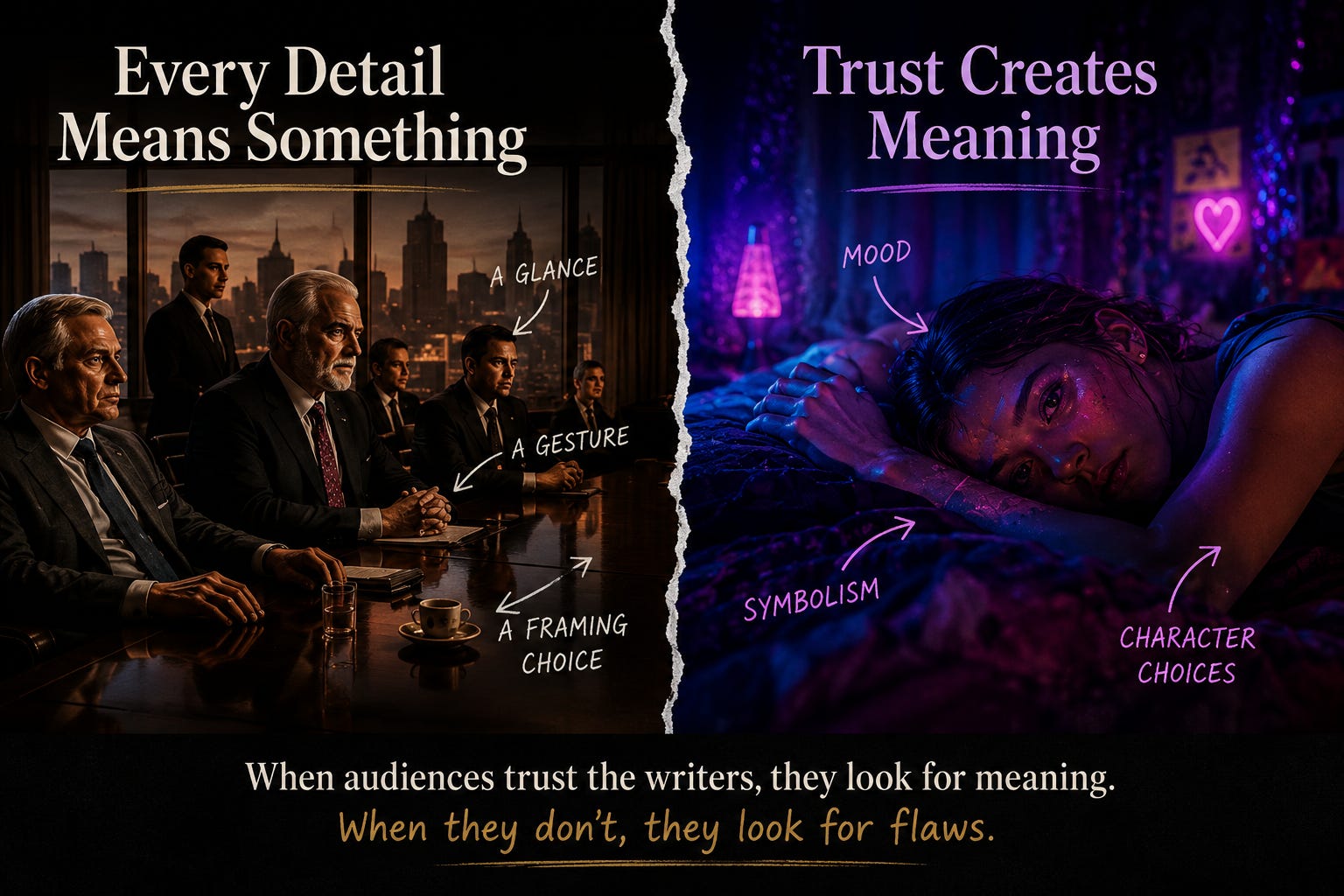
Shows like Succession reward obsessive attention to detail. A glance, an uncomfortable pause, or a specific shot composition can fuel pages of online discussion because audiences trust that those choices were deliberate. They believe there is a coherent vision behind the writing, directing, and visual storytelling.
That trust is what makes interpretation possible.
People do not analyze stories for the sake of analyzing them. They analyze them because they believe it is worth their time.
Yes, It Really Is That Deep
As a writer, I can tell you that it often is that deep.
Before a script ever reaches production, years of work may have already gone into character profiles, story outlines, discarded drafts, and discussions about motivations, symbolism, and narrative arcs. Then come the contributions of directing, production design, cinematography, makeup, costume design, and editing. When all of those elements align, a story conveys a sense of purpose. When they do not, the result can feel strange, inconsistent, or even accidental.
That is why the debate surrounding the new season of Euphoria is not really about the time jump.
It is about credibility.
Narrative trust functions as a kind of emotional credit between creators and audiences. When a show accumulates enough of that credit, viewers are willing to follow it through its boldest creative decisions. When it loses that credit, every new choice begins to invite suspicion.
The Erosion of Trust
Over the last several years, Sam Levinson has become the center of a number of public controversies that have affected how audiences perceive his work.
The critical failure of The Idol, discussions surrounding the treatment of female characters in his stories, and the ongoing conversations about Petra Collins’ influence on Euphoria’s original visual identity have all contributed to eroding the image of the meticulous auteur that once surrounded the series. Together, these discussions have raised questions about how much of Euphoria’s early success can truly be attributed to Levinson’s creative vision.
Added to that are years of rumors involving production conflicts, delays, creative changes, and tensions within the cast. Whether those rumors are true or not is almost beside the point. They inevitably influence the way audiences interpret the series.
Because audiences do not consume stories in isolation.
They also consume interviews, headlines, leaks, TikToks, YouTube videos, podcasts, and endless social media discourse. Over time, all of those pieces become part of the viewing experience.
As a result, many viewers no longer approach Euphoria asking:
“What does this mean?”
Instead, they ask:
“Did it ever mean anything in the first place?”
And that difference is enormous.
In Defense of the Story
From a narrative perspective, many of the show’s recent changes make perfect sense.
Nate is no longer at the top of the artificial hierarchy of high school. Much of his power came from that environment, where he was attractive, popular, and the star football player. It makes sense that his position would be different when confronted with adulthood. In fact, it feels like a realistic evolution of the kind of person who appears to have peaked in high school, only to discover that the rules that once made them successful no longer apply outside that world.
Maddy also had to change. After everything she experienced during the previous seasons, it would have felt strange to see her reacting in exactly the same ways. Maturity does not eliminate a person’s conflicts, but it does change how they confront them.
Jules may be the most interesting case of all. Her identity has always been a work in progress. The fact that she presents herself differently now than she did as a teenager does not necessarily contradict the character. It could simply be the natural continuation of her evolution.
The problem is not that the characters have changed.
The problem is that part of the audience no longer trusts that those changes are leading somewhere meaningful.
And that raises a fascinating question: would viewers be reacting the same way if these exact same story developments had been written by someone they still trusted?
Because when audiences trust a creator, they tend to assume there is a plan.
When they do not, they tend to assume the opposite.
The Real Problem
Maybe the new season of Euphoria will ultimately prove those doubts wrong.
Maybe it will not.
But what makes the phenomenon interesting is that it reveals something we often overlook: stories do not depend solely on their characters. They also depend on the relationship between the people who create them and the people who consume them.
A television series can survive unpopular characters, controversial creative decisions, time jumps, and even disappointing seasons.
It can ask its audience for patience.
What it cannot do is demand faith.
Because once trust disappears, every decision stops looking like a promise and starts looking like an explanation waiting to happen.
And few things are harder to recover than the trust of an audience.